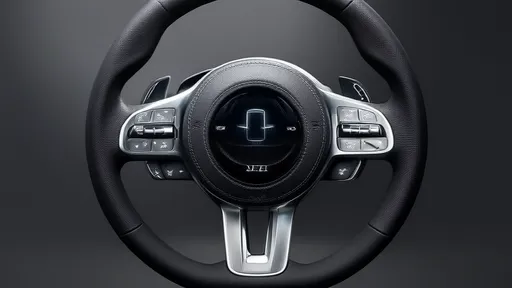
The automotive industry has seen remarkable advancements in driver-assistance systems and immersive driving experiences over the past decade. Among these innovations, force feedback steering wheels have emerged as a critical component, bridging the gap between virtual simulations and real-world driving dynamics. At the heart of this technology lies torque precision—a parameter that dictates how accurately the steering wheel replicates the resistance, vibrations, and nuances of road conditions. Achieving high torque accuracy is not just a matter of engineering prowess; it fundamentally transforms how drivers interact with vehicles, whether in gaming setups or advanced driver training simulators.
Torque precision in force feedback steering systems refers to the wheel's ability to deliver exact rotational resistance in response to software inputs or physical forces. For instance, when a virtual car hits a curb or loses traction on a slippery surface, the steering wheel must instantaneously reflect these changes with the appropriate torque feedback. Even minor deviations in torque output can break the immersion or, worse, provide misleading cues to the driver. This is why manufacturers invest heavily in high-resolution encoders, brushless motors, and advanced control algorithms to minimize latency and torque ripple.
One of the biggest challenges in maintaining torque accuracy is overcoming mechanical inertia and friction within the steering system. Traditional gear-driven mechanisms often introduce unwanted damping effects, which can blur the fine details of torque feedback. To combat this, companies like Fanatec and Logitech have adopted direct-drive systems, where the motor is directly coupled to the steering shaft. This design eliminates intermediary components that could distort feedback, resulting in torque responses that are both faster and more precise. The difference is palpable—users report feeling every pebble on the road, subtle understeer tendencies, and even the weight transfer during aggressive cornering.
Beyond hardware, software calibration plays an equally vital role in torque precision. Modern force feedback systems rely on dynamic tuning algorithms that adjust torque output in real-time based on vehicle speed, tire grip, and suspension load. For example, a racing simulator might reduce steering resistance as the car accelerates to mimic the decreasing downforce at high speeds. These algorithms must account for countless variables without introducing perceptible lag—a task that requires meticulous programming and iterative testing. Some developers even incorporate machine learning to adapt torque profiles to individual driving styles, further enhancing the realism of the feedback.
The implications of high torque precision extend far beyond entertainment. In automotive research and development, force feedback steering wheels with exceptional torque accuracy are used to test prototype vehicles in virtual environments. Engineers can simulate how a new suspension setup or tire compound would behave before physical prototypes are built, saving millions in development costs. Similarly, driver training programs for emergency responders leverage precise torque feedback to teach vehicle control during extreme maneuvers. The ability to faithfully reproduce the steering feel of a skidding car, for instance, can be lifesaving in real-world scenarios.
Looking ahead, the demand for even greater torque precision will likely drive innovations in materials and control systems. Emerging technologies like magnetic torque sensors and haptic actuators promise to push the boundaries of what's possible, potentially eliminating the last remaining gaps between simulated and actual driving experiences. As these advancements trickle down from professional-grade equipment to consumer products, drivers and gamers alike stand to benefit from steering systems that don’t just respond to their inputs—but truly communicate with them.

By /Aug 15, 2025
By /Aug 15, 2025

By /Aug 15, 2025
By /Aug 15, 2025
By /Aug 15, 2025

By /Aug 15, 2025
By /Aug 15, 2025

By /Aug 15, 2025
By /Aug 15, 2025

By /Aug 15, 2025
By /Aug 15, 2025

By /Aug 15, 2025

By /Aug 15, 2025

By /Aug 15, 2025

By /Aug 15, 2025

By /Aug 15, 2025
By /Aug 15, 2025

By /Aug 15, 2025

By /Aug 15, 2025

By /Aug 15, 2025
